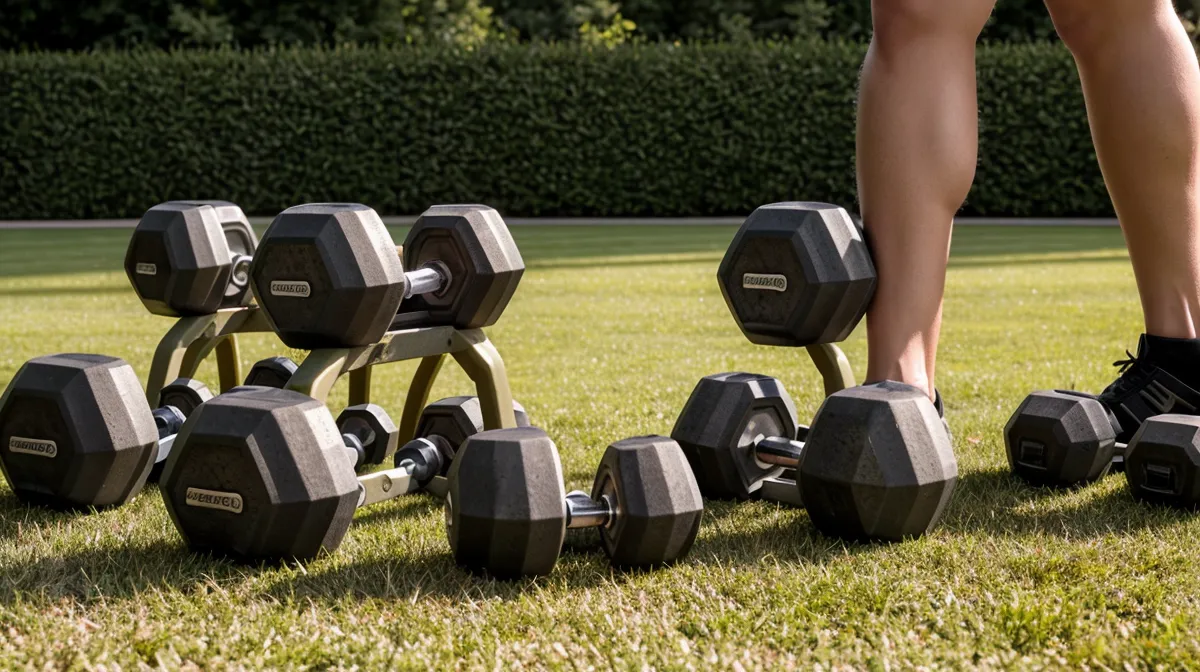
Three days a week. That's the entire deliberate workout schedule behind boosting my metabolism after 50, and for a long time I assumed a number that small couldn't possibly beat someone logging five or six days of hard cardio. My neighbor is deep into training for a 5K with the neighborhood running club, doing hill repeats and tempo runs most mornings out along Cherry Creek Trail. Watching him, I used to think that kind of daily mileage was the only real route to a faster metabolism after 50, the kind of strength training after 50 nobody actually talks about. It isn't, and laying our two routines side by side is the fastest way to see why.
My doctor didn't leave much room for subtlety at my last physical. He used the phrase "well, at your age" so many times I started glancing around the waiting room for retirement brochures, then told me to just add more cardio. So I did, briefly, and mostly ended up with a sore lower back and a golden retriever who was thoroughly confused by suddenly being dragged past every bush instead of allowed to sniff it.
The Running Club vs. the Garage: Two Ways to Chase the Same Goal
Here's what his week actually looks like: near-daily runs, climbing mileage, a tempo session or two, and a long Sunday run along the trail to build endurance for race day. It's a legitimate way to train for a 5K, and it will absolutely burn calories in the moment. What it won't necessarily do, at least not by itself, is protect the muscle that keeps a middle-aged metabolism from sliding backward.
My week looks almost boring by comparison. Three days of basic resistance work, squats, presses, rows, done slowly and without any ego involved, plus a lot of ordinary walking and standing in between. No hill repeats, no tempo runs, nothing that needs a training plan with colored heart-rate zones on it. The difference isn't about which one of us works harder. It's about which one actually addresses the thing that slows metabolism down after 50 in the first place.
Why Daily Cardio Can Backfire on Men's Metabolism After 50
The problem with daily cardio is that your body adapts to it, and it adapts fast. Run the same five miles every morning and within a few weeks your body gets remarkably efficient at burning less energy to cover that same distance. Add in a rough night's sleep now and then, which does its own quiet damage to metabolism in ways that rarely get talked about, and a hard training week can leave you with less energy for everything else you're supposed to do that day, not more. Basal metabolic rate, the energy you burn just existing, breathing, and keeping your heart beating, makes up something like 60 to 75 percent of total daily energy expenditure. An hour of gasping on a bike is a much smaller slice of that pie than most guys assume.
Muscle loss compounds the problem. After 30, most men lose something like 3 to 8 percent of their muscle mass per decade, and by your 50s that adds up to a noticeably smaller engine than the one you had at 25 unless you're actively fighting to keep it. Declining testosterone plays into that too, chipping away at muscle mass retention in a way that hits your resting calorie burn harder than the number on the scale would suggest. None of that shows up if you only measure success in miles run.
What Actually Boosts Resting Calorie Burn?
Holding onto muscle tissue matters more than torching calories in any single session, since muscle costs energy to maintain around the clock. Three slow, controlled sessions a week, squats, rows, presses, done with real control instead of ego, protect that tissue far better than another cardio session would. It's not about lifting heavy for the sake of lifting heavy. It's about giving your body a reason to keep the muscle it already has instead of slowly cannibalizing it.
Alongside the lifting, I lean on NEAT, or non-exercise activity thermogenesis, a fancy way of describing all the incidental movement in an ordinary day: taking the long way through the store, standing for phone calls, walking the dog around the neighborhood instead of just letting him out in the yard. Before I landed on this combination, I went the opposite direction and tried a hardcore 16:8 intermittent fasting protocol for six weeks straight, eating nothing until noon and nothing after 8 p.m. It made me hangry, foggy by mid-morning, and didn't move my waistline at all. Frequent, low-intensity movement did more for me in less time than starving myself on a schedule ever did.
Diet mattered too, though not in a restrictive way. Protein has a thermic effect of roughly 20 to 30 percent, meaning your body burns a real chunk of those calories just digesting them, compared to a much smaller share for fat or carbs. That's part of why weight management now starts with what's on my plate before it starts with what's on the bar, and why I rebuilt my mornings around protein instead of just coffee, something I got into after why I traded my 6 AM coffee ritual for a 15-minute protocol. Small shift, real difference in how steady my energy feels by midafternoon.
Stiff joints deserve a mention here too. If squatting hurts before the bar even has weight on it, mobility work earns a spot in the rotation before any amount of heavier lifting does. One ordinary Sunday morning made the whole approach click for me: I woke up at 6:30 with no alarm and, for once, didn't feel like I'd been run over by a truck. My golden retriever was already doing laps around the backyard for no reason at all, which is a level of morning energy no strength program will ever match. I've also noticed the afternoon mental fog that used to hit hard shows up a lot less now, and I've written separately about is brain fog normal after 50 or should I be worried? if that sounds familiar.
Choosing Between the Two, Not Splitting the Difference
If you're actually training for a race, the running club approach makes sense, and no amount of garage lifting replaces the specific fitness a 5K demands. But if the goal is simply keeping your metabolism working in your favor after 50, without wrecking your knees or your Sunday mornings, three days of resistance work plus ordinary daily movement does more with less. Choose the mileage when you have a start line to cross. Choose the weights and the walking when the goal is staying capable for the next few decades.
These days, morning hikes in Denver feel less like a chore for my joints now, mostly because I'm not layering high-impact miles on top of everything else. My neighbor will get his medal at the finish line, and I'll get to keep buttoning my jeans without wrestling. Both of those count as wins. Talk to your own doctor before you start swinging weights around, but don't assume the treadmill is the only tool in the box.